Seattle Premium Decks
Service Line

Slope, Shoreline & ECA-Zoned Decks

Engineered carpentry for Seattle’s steep, sensitive, and waterfront parcels.

A meaningful share of Greater Seattle’s most desirable parcels sit on terrain that disqualifies a conventional deck builder. Slopes above thirty percent demand engineered foundations. Environmentally Critical Area overlays demand a permit before the first post hole. Properties within two hundred feet of the Ordinary High Water Mark fall under the Washington Shoreline Master Program. Washington State requires forty-two inch guards and a sixty pounds-per-square-foot live load, both stricter than the International Residential Code baseline. Combined, these constraints describe a class of projects most builders avoid, decline to permit, or quietly build without one.

Our practice is built around exactly this class of work. We operate as a structural and municipal navigator: structural in the sense that our drawings carry stamped Professional Engineer calculations and our foundations reach stable glacial till; municipal in the sense that we file the permit in the homeowner’s name, share the SDCI or jurisdiction tracking number on day one, and absorb the geotechnical review process so the homeowner doesn’t inherit a paperwork backlog at handoff. The goal isn’t a deck that survives the inspection. It’s a deck that survives the slope, the soil, the rain, and the resale.
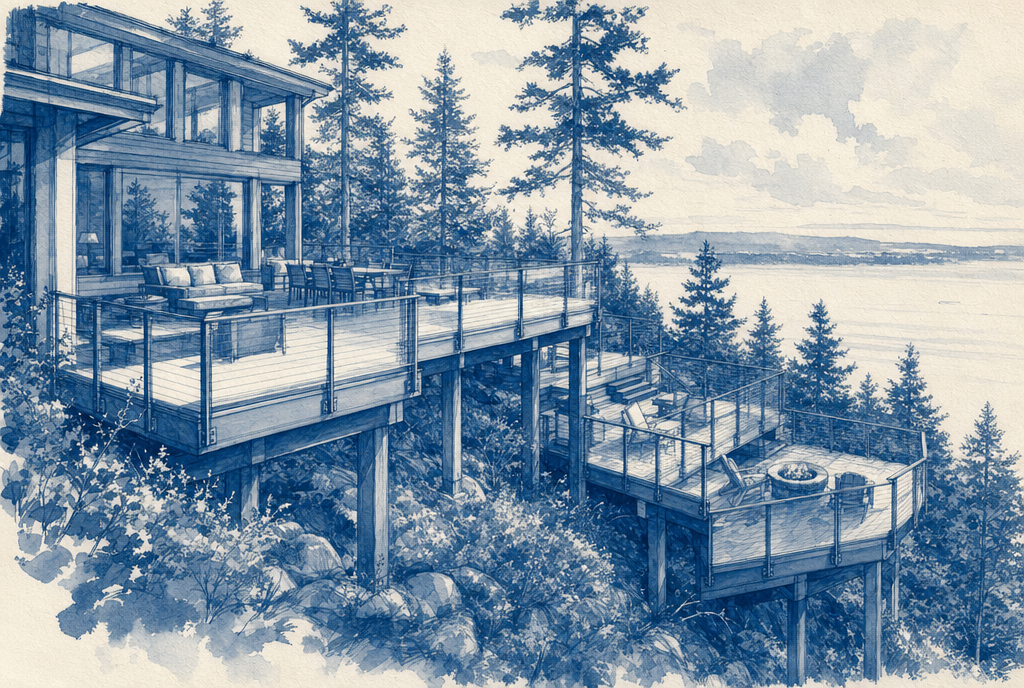
What Counts as Slope, ECA, or Shoreline

Slope projects

Anything over a ten percent grade is no longer a flat-lot deck and starts to drive structural decisions on post lengths and lateral bracing. Above thirty percent grade is our standard threshold for engineered footings rather than poured concrete pads. Above forty percent grade in the City of Seattle, the parcel falls inside the SDCI Environmentally Critical Area steep-slope designation by definition, which triggers a separate review pathway.

Environmentally Critical Areas (ECA)

ECA is a Seattle SDCI overlay that includes steep slopes greater than forty percent, landslide-prone areas, liquefaction zones, peat element zones, flood-prone areas, wetlands, and riparian corridors. Any deck inside an ECA requires a construction permit, regardless of height above grade — the eighteen-inch threshold that exempts low decks elsewhere in Seattle does not apply. Steep-slope ECA further requires a geotechnical hazard review and stamped drawings from a licensed Professional Engineer. Other jurisdictions in the MSA carry analogous overlays; the substance is the same even when the label differs.

Shoreline & waterfront

Construction within two hundred feet of the Ordinary High Water Mark activates the Washington Shoreline Master Program, administered locally with jurisdiction-specific envelopes. Mercer Island enforces a twenty-five foot landward setback from the OHWM; Medina restricts envelope changes that affect the fire-rated assembly; over-water dock decking must allow at least sixty percent grated open area for light penetration. A waterfront deck is a permitting conversation before it is a carpentry conversation.

Our Process for Slope & ECA Jobs

Five sequential stages, every one of them documented in the permit file.

  1. 01

    Site assessment & slope reading

    Topographic walk of the parcel with grade measurement, ECA overlay verification through Seattle SDCI GIS or the equivalent jurisdiction layer, and a first-pass call on what the foundation system will need to be. We also locate the Ordinary High Water Mark on shoreline parcels and confirm the 200-foot Shoreline Master Program trigger.

  2. 02

    Geotechnical review with named PE partner

    Slopes greater than 40% in Seattle SDCI ECA territory trigger mandatory geotechnical review with stamped drawings. We coordinate the soil report, the structural calculations, and the response letters that the reviewer will ask for. Our geotechnical partner is named at quote stage so the homeowner knows who is signing the calcs before the contract is signed.

  3. 03

    Structural design to WA 60-psf live load

    Washington State requires residential deck framing engineered for a 60 pounds-per-square-foot live load, higher than the IRC baseline. We design ledger attachments, beam spans, post connections, and guard load paths to 2021 IRC Section R507.10 with the WA-specific 42-inch guard height. No notched 4x4 guard posts at the connection point. Continuous load path from rail to footing, documented in the permit set.

  4. 04

    Permit filing in the homeowner's name

    Per Washington law, the contractor pulls the permit in the homeowner's name. We file with Seattle SDCI, City of Bellevue, or the applicable jurisdiction and share the tracking number on day one. Standard SDCI ECA reviews run 10 to 17 weeks; we account for that in the construction schedule and flag dependencies before they become delays.

  5. 05

    Build with engineered foundation system

    On most slope and ECA parcels we install helical steel piers or Diamond Pier pin-pile foundations. Both reach past the creeping topsoil layer into glacial till without excavation. Concrete footings are used selectively on flatter ECA buffer parcels where ground disturbance is acceptable to the reviewer. Materials and connections meet the substructure spec we engineered, not what's cheapest on the truck.

Engineered Foundations Compared

We treat foundation selection as the most consequential structural decision on any slope or ECA project. Read our journal essay on helical pier engineering for a long-form treatment of glacial till geology, root-zone preservation, and the SDCI ECA review pathway.

Helical steel piers

Best for
Steep slopes >30%, ECA-designated parcels, retrofits where excavation would damage mature roots or existing structures.
Site disturbance
Near-zero. Driven hydraulically; no spoil pile, no concrete pour at the ground line.
Depth & verification
Typically 8-15 feet to refusal in dense glacial till. Verified torque-to-capacity reading at install.
Loadable when
Immediate load. Construction continues the same day.

Diamond Pier (engineered pin pile)

Best for
Slope and ECA parcels with an ICC-ES Evaluation Report acceptable to the local reviewer; mid-size residential decks where helical mobilization is not justified.
Site disturbance
Minimal. Precast concrete head sits at grade; four pins drive through the head at engineered angles.
Depth & verification
Pins reach roughly 50 inches below the head, deeper with extensions. Verified by drive count.
Loadable when
Immediate load.

Traditional poured concrete footings

Best for
Flat lots outside ECA, low decks below permit thresholds, or sites where reviewer requires conventional Section R403 footings and excavation is acceptable.
Site disturbance
High. Each footing requires a hole below the frost line, spoils management, and form work. Disturbs root structure of mature vegetation.
Depth & verification
Hole depth varies; concrete pad rests below frost line and bears on competent soil.
Loadable when
7 to 28 days before structural load can be placed on the post.

Materials Specified for Slope & ECA Work

Hillside and shoreline parcels share an environmental envelope — persistent rain, marine air, freeze-thaw cycles, and limited drying sun — that punishes wood-flour composites and ages softwoods rapidly. We specify three categories of board where the warranty math, dimensional stability, and supply-chain ethics all align.

TimberTech AZEK Vintage

Capped polymer PVC

Solid-PVC core with a co-extruded cap. Moisture-immune, dimensionally stable across freeze-thaw cycles, 50-year limited residential warranty. The right choice on shaded north-facing slopes and shoreline decks where condensation and rain dwell on the board surface.

Deckorators Voyage

Mineral-based composite

Mineral-rich core resists moisture absorption better than wood-flour composites and stays cooler underfoot than dark PVC. Holds dimensional stability over long unsupported spans where slope framing forces wider joist bays.

Sustainable alternative to Ipe

Thermally modified ash

Heat-and-steam treatment alters cell structure to produce a stable, decay-resistant board from FSC-eligible North American ash. We specify it where homeowners want the look and feel of tropical hardwood without sourcing through Ipe channels — Brazilian Ipe (Handroanthus spp.) carries CITES Appendix II restrictions and increasingly unreliable PNW supply.

Regional Service Pages

Slope, soil, and jurisdiction differ measurably across the MSA. We publish a focused page for each of the three highest-velocity hillside service areas.

Start the Conversation

Discuss a slope or ECA-zoned project.

Bring a parcel address, a sketch, or a set of architectural drawings. We’ll respond with a feasibility read, a likely foundation system, and a permit-pathway estimate within two business days.

Budget Ranges

See cost ranges for engineered hillside decks.

Our cost-cluster pages publish 2026 installed ranges with permit-fee, sales-tax, and tariff context broken out line-by-line — including the geotechnical and helical pier add-ons specific to ECA parcels.