Slope & ECA Decks on Queen Anne
View-preserving structural carpentry on one of Seattle’s densest hillside neighborhoods.
Why Queen Anne Is Different
Queen Anne is two slope problems in one neighborhood. The north slope of Queen Anne Hill drops sharply toward the Lake Washington Ship Canal and Fremont, with view-preserving deck work concentrated on parcels above Nickerson and Florentia. The west side of the neighborhood — commonly called West Queen Anne — drops toward Interbay and the Magnolia Bridge, with another tranche of hillside parcels organized around Tenth Avenue West and Eighth Avenue West. Both slopes regularly cross the thirty-percent grade threshold that drives engineered foundations, and stretches of both touch the Seattle SDCI Environmentally Critical Area overlay.
What makes Queen Anne a category of its own, separate from West Seattle, is density and vintage. The neighborhood was substantially built out between the 1900s and the 1960s. Many of the homes we work on have foundations and ledger details that predate not just the 2021 International Residential Code but the structural philosophy behind it — continuous load paths, ledger-bolt patterns, lateral connections at the rim joist. A Queen Anne deck retrofit is rarely just a board swap. It is a structural conversation about how the new deck attaches to a sixty-or-more-year-old framing system and what has to be upgraded at the ledger to meet current code.
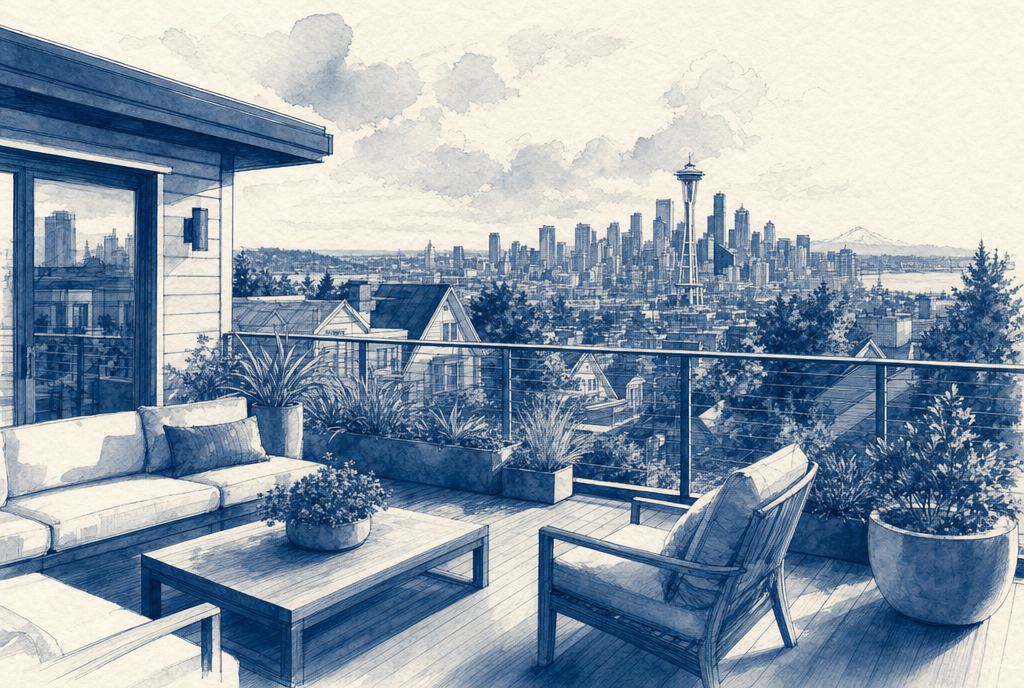
The other defining feature is the view envelope. Queen Anne homeowners pay a measurable premium for sight lines to Elliott Bay, the Olympics, Lake Union, or downtown. A deck that obstructs that envelope — with bulky 4x4 newels, opaque guard panels, or oversized framing — spends down the asset the homeowner is trying to protect. Material and railing selection on Queen Anne is therefore as much an architectural decision as a structural one.
Permit Pathway — Seattle SDCI
Queen Anne sits inside the City of Seattle, so the permit pathway runs through Seattle SDCI. Any deck more than eighteen inches above grade, any roof deck, and any deck on a parcel inside the Environmentally Critical Area overlay requires a construction permit. Steeper Queen Anne parcels — especially on the north slope — will trigger the ECA designation and require a geotechnical hazard review with stamped drawings.
Where Queen Anne diverges from West Seattle in practice is that more of the work here is retrofit. Replacing a 1960s-era deck on a 1910 home means we are filing under the 2021 IRC R507.10 continuous load path regime against framing that was never designed with that detail in mind. Expect the permit set to include a structural connection drawing for the ledger, an updated guard post connection (no notched 4x4 posts at the connection point — this detail was once standard and is now explicitly prohibited), and a load-path callout from the guard rail down to the deck framing to the new foundation.
We file in the homeowner’s name as Washington law requires and share the SDCI tracking number on day one. The permit number stays attached to the property record; it is part of the resale disclosure, and a permit-tracked deck is a clean diligence item for future buyers.
Common Project Archetype
The recurring Queen Anne project is a partial cantilever off the rear elevation of a turn-of-the-century or mid-century home, sized to capture a specific view line. The foundation system on the slope side is helical steel piers driven through the topsoil to glacial till. The framing engages the existing rim joist with a structural ledger detail upgraded to current R507.10 standards — commonly an additional steel angle, a thru-bolt pattern verified by a Professional Engineer, and supplemental lateral-load anchors.
On the view side we default to a low-profile stainless steel cable rail system. The cable is engineered to resist the 200-pound concentrated guard load in vertical and horizontal directions per R507.10 and meets the four-inch baluster sphere rule at the cable spacing typical for forty-two inch Washington-amended guard height. Where the homeowner prefers glass, we specify frameless tempered glass on 316 marine-grade stainless spigots; the spigot pattern is engineered against the same guard load case and the glass thickness is sized to the panel run.
For projects involving the original framing, we plan for selective structural exposure during demolition. A Queen Anne deck retrofit nearly always discovers something at the ledger that has to be addressed before the new deck attaches — rotted sheathing, undersized framing, a non-compliant flashing detail, or a previous repair done without a permit. We allowance for it explicitly in the contract rather than treating it as a change order.
Cost Ranges for Queen Anne Hillside Work
Queen Anne projects sit toward the upper end of the regional installed-cost band because retrofit work into older framing routinely involves ledger upgrades, structural exposure during demolition, and view-grade rail systems. Our cost-to-build-a-deck-in-Seattle page publishes 2026 ranges with the SDCI permit-fee schedule, the Washington 10.35% sales tax, the Jan-2026 Trex tariff line, and view-rail upgrades broken out separately so retrofit math is visible.
Why the Foundation System Matters
Queen Anne’s subsoil is the same Vashon glacial till sequence found across the central Sound region: a topsoil layer that creeps over decades sitting on top of dense glacially compacted till. Helical piers and Diamond Pier engineered pin piles bypass the creeping layer and seat the structure in stable till. Read our journal essay on helical pier engineering for the long-form treatment of root-zone preservation, the case against poured concrete on a steep grade, and how a low-impact foundation accelerates the SDCI ECA review.
The neighborhoods named here are our service target. Project case studies, with permit numbers and structural engineer credits, will publish as projects reach completion.
Start a Queen Anne Project
Send us a parcel address, a sketch, or architectural drawings. We’ll respond within two business days with a feasibility read, a likely ledger and foundation strategy, and an SDCI permit-pathway estimate.