Slope & ECA Decks in West Seattle
Engineered carpentry on the steepest residential terrain in the city.
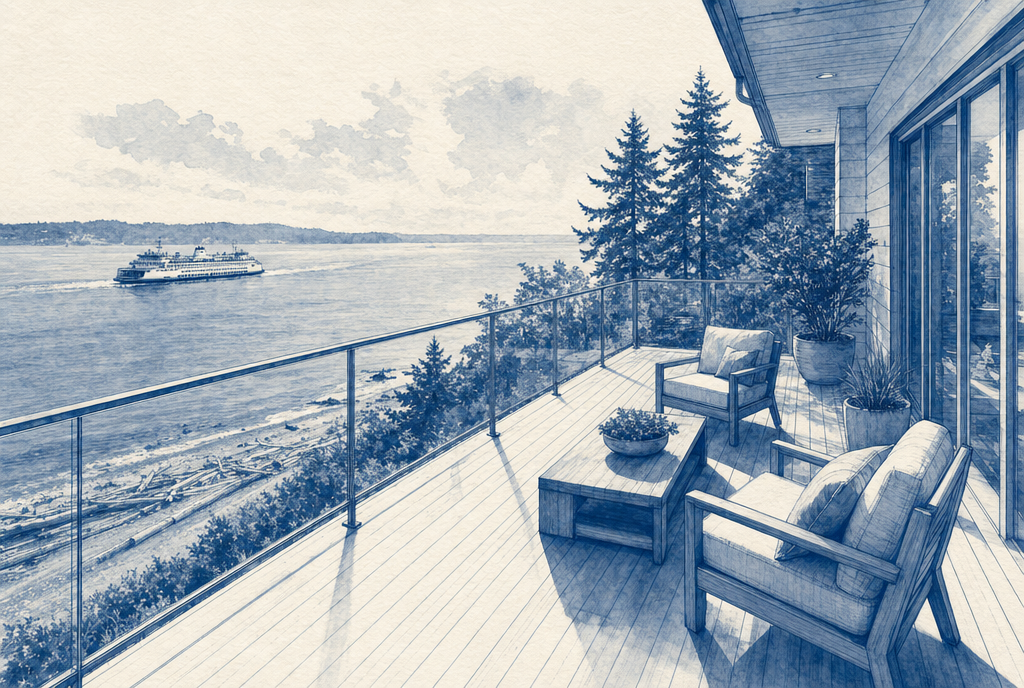
Why West Seattle Is Different
West Seattle’s topography is the reason we take this neighborhood seriously. The peninsula climbs from the Duwamish and Elliott Bay shoreline through a series of glacially carved bluffs — Alki, North Admiral, Genesee Hill, Highland Park, Pigeon Point — with single-family residential parcels routinely sitting on grades above thirty percent. Many parcels touch the City of Seattle’s forty-percent steep-slope threshold, which places them inside the SDCI Environmentally Critical Area overlay by definition.
That topography also explains why hillside deck recommendations move faster on West Seattle neighborhood channels than anywhere else in the city. Homeowners on the slope live with two structural realities at once: a sloped lot that wants to creep and a view envelope they paid a premium to inherit. Most builders avoid the parcels for the first reason and over-promise on the second. A well-engineered deck resolves both.
The geology underneath the topography is the third reality. West Seattle’s subsoil is the same Vashon glacial till sequence that underlies most of the central Sound region: a loose to medium-dense topsoil layer over dense glacially compacted sand and gravel. The top three to five feet creep downhill over decades. Anything load-bearing must reach past that layer into the till below. That single constraint determines the foundation system on nearly every project we take on west of California Avenue.
Permit Pathway — Seattle SDCI ECA
Seattle Department of Construction & Inspections requires a construction permit for any deck more than eighteen inches above grade, any roof deck, and any deck inside an Environmentally Critical Area — regardless of height. Most West Seattle hillside parcels fall into that ECA bucket because of the slope overlay. Simple decks above eighteen inches but below eight feet of elevation can be filed as Subject-to-Field-Inspection. Complex decks — multi-level, long-span beams, roof decks, or any ECA parcel — require the full Addition/Alteration construction permit.
For ECA steep-slope parcels, the city additionally requires a geotechnical hazard review with a soils report and stamped engineering drawings from a licensed Professional Engineer. Standard review times run ten to seventeen weeks. We file the permit in the homeowner’s name, as Washington law requires, and share the SDCI tracking number on day one so the homeowner can verify status through the city’s online portal at any point in the process.
We want to be direct about why this matters. The single most common red flag flagged by West Seattle homeowners on neighborhood forums is a contractor pushing “no permit needed” on an elevated deck on a slope. The risk is not theoretical. An unpermitted hillside deck creates structural liability for the owner, a disclosure obligation at resale, and accumulating code-violation penalties when the city catches it. Pulling the permit is the cheaper option even before construction begins.
Common Project Archetype
The recurring West Seattle archetype is a mid-century or earlier home perched at the top of a forty-percent grade with a primary view orientation north or west toward the Sound. The original deck — usually a 1980s or 1990s cedar build — has begun to soften at the ledger, sag at the cantilever, or fail at the guard connection. Replacement on the same footprint is rarely the right answer. Most parcels benefit from a deeper cantilever, an updated lateral connection to the rim joist, and a foundation system that doesn’t depend on the topsoil layer.
Our default configuration on this parcel type is a cantilevered framing system seated on helical steel piers or Diamond Pier engineered pin piles, with a continuous load path documented from the guard to the footing per 2021 IRC Section R507.10. Posts extend through the framing rather than being notched at the connection — the notched 4x4 post detail is no longer code-compliant. Guard height is forty-two inches per the Washington State amendment, not the thirty-six inch IRC baseline, which affects railing system selection and material quantities and is frequently missed in cheaper quotes.
On view-critical orientations we specify low-profile stainless steel cable railing or frameless tempered glass with 316 marine-grade stainless spigots. Both systems preserve sight lines while meeting the 200-pound concentrated guard load required by R507.10 in vertical and horizontal directions.
Cost Ranges for West Seattle Hillside Work
West Seattle hillside projects sit at the upper end of the regional installed-cost band because the foundation system, the geotechnical line item, and the permit complexity all stack. Our cost-to-build-a-deck-in-Seattle page breaks out 2026 permit fees, the Washington 10.35% sales tax, the Jan-2026 Trex tariff impact, and the geotechnical/helical premium — line by line, no flat-rate handwaving.
Why the Foundation System Matters
On a West Seattle slope, the foundation is the deck. Get it wrong and every other choice — the boards, the rail, the cantilever — becomes a liability rather than a feature. Read our journal essay on helical pier engineering for the long-form treatment: soil shear stress in the topsoil layer, the case against poured concrete on a thirty-percent grade, root-zone preservation as a permit-acceleration lever, and why a sixty pounds-per-square-foot live load is the floor — not the ceiling — for any deck we build on this terrain.
The neighborhoods named here are our service target. Project case studies, with permit numbers and geotechnical engineer credits, will publish as projects reach completion.
Start a West Seattle Slope Project
Send us a parcel address or a set of drawings. We’ll respond within two business days with a feasibility read, a likely foundation system, and an SDCI ECA review timeline estimate.